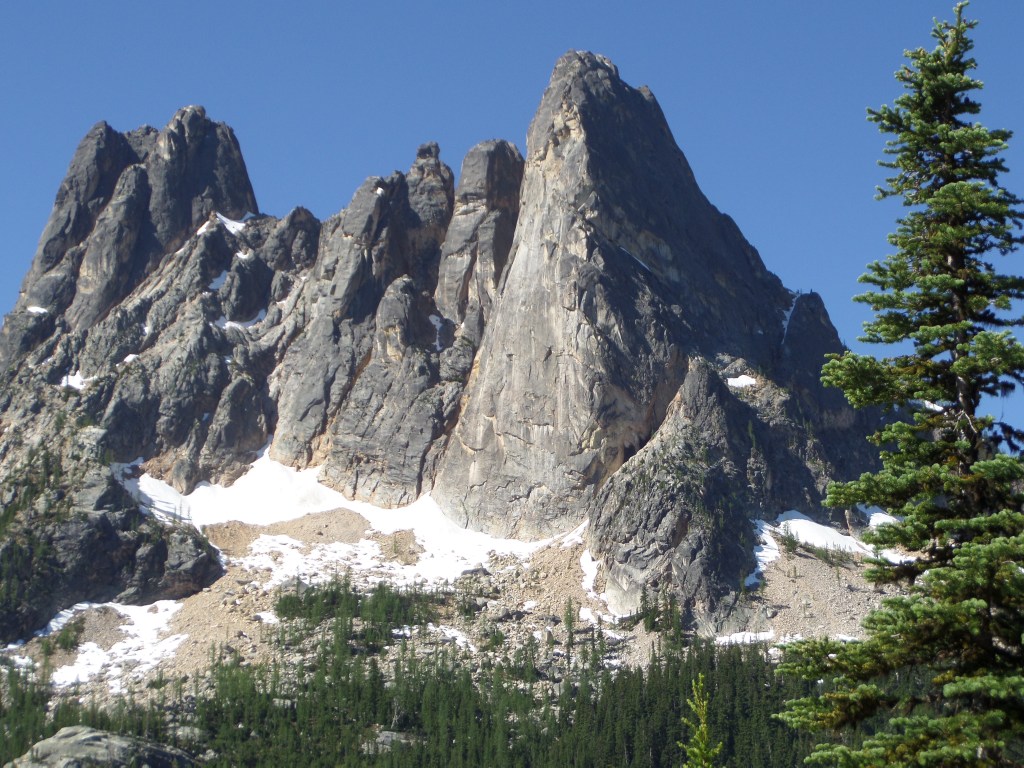
Liberty Bell Mountain

Current image: Liberty Bell Mountain looms large above Washington Pass.

Photo by Tim Clinton

Liberty Bell Mountain looms large above Washington Pass on Washington’s North Cascades Highway.

By Tim Clinton

What comes to mind when you hear the phrase Liberty Bell?

Chances are you think of a cracked patriotic bell in Philadelphia.

But in the state of Washington it takes on a different meaning as a jagged mountain on the North Cascades Highway.

The northern portion of the Liberty Bell Massif series of peaks is bell shaped with a giant crack in it and thus earns the name Liberty Bell Mountain.

The massif as a whole resembles a cathedral or castle, and it towers above Washington Pass on Highway 20, with the best place to view it being the Washington Pass Overlook.

It is part way up the massif but out a ways, presenting a view of the east side of the mostly north-south running ridgeline.

Liberty Bell Mountain is the tallest point on the right as viewed from the overlook, standing at 7,720 feet above sea level.

The Early Winters Spires South stands out like a lookout tower on the left side, with the overlook also offering a view down toward Mazama and Winthrop.

It can also be seen from the west including from places in the Skagit Valley, but the best way to see it — and all of the North Cascades for that matter — is from the east going west.

The Washington Pass Overlook is at the end of a short pull off road and features a wide parking area and a short walk through alpine firs to the viewpoint.

The granite massif also stands like a lure for adventurous climbers, with the top of the Liberty Bell Mountain portion not reached until 1946.

How to get there:

Liberty Bell Massif and Washington Pass are located just east of North Cascades National Park on Highway 20.

They can be accessed from the east from the Methow Valley. To get to Highway 20 and the valley, take Highway 2 from Snohomish and Monroe just north of Seattle and head east, or take Highway 2 heading west out of Spokane.

Turn north on Highway 97 or 97A at Wenatchee until they converge in Chelan and keep going north to Highway 153, turning left onto it near Pateros. This cutoff takes you to Highway 20 at Twisp, where you turn left to head west.

There are two more options from west to east off Interstate-5. You can take Highway 530 near Arlington and join Highway 20 in Rockport, where you take a right.

You can also hop directly onto Highway 20 further north at the Burlington exit, turning right.
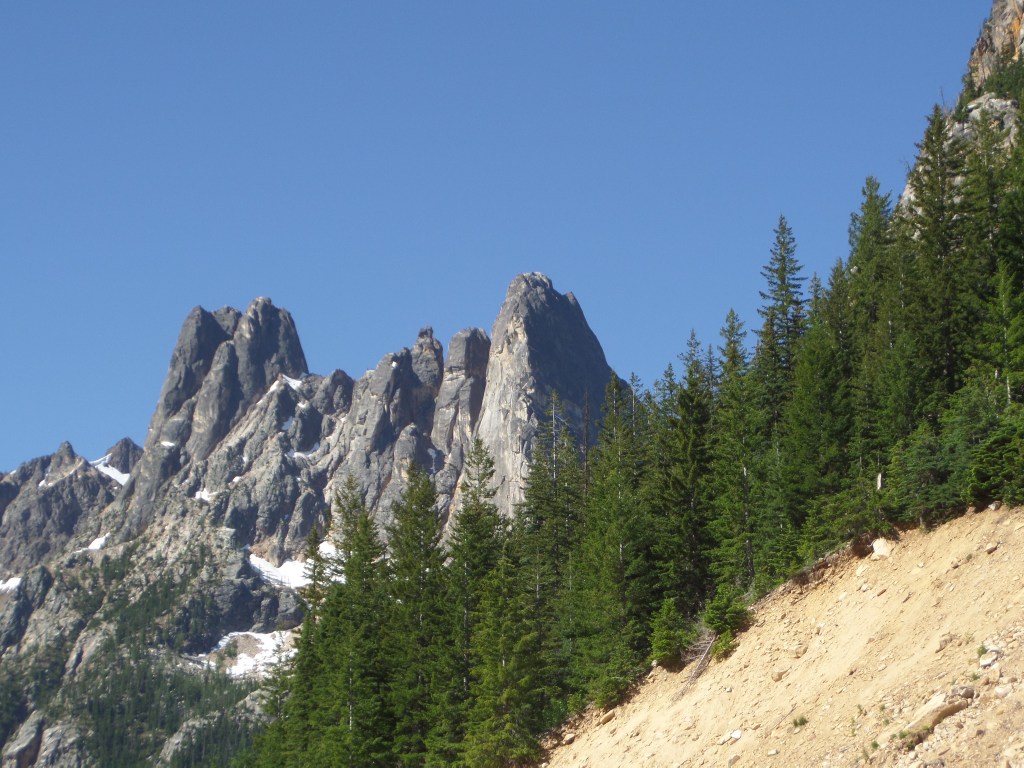
SAMSUNG CAMERA PICTURES

Photo by Tim Clinton

Liberty Bell Massif as viewed from farther east on Highway 20.
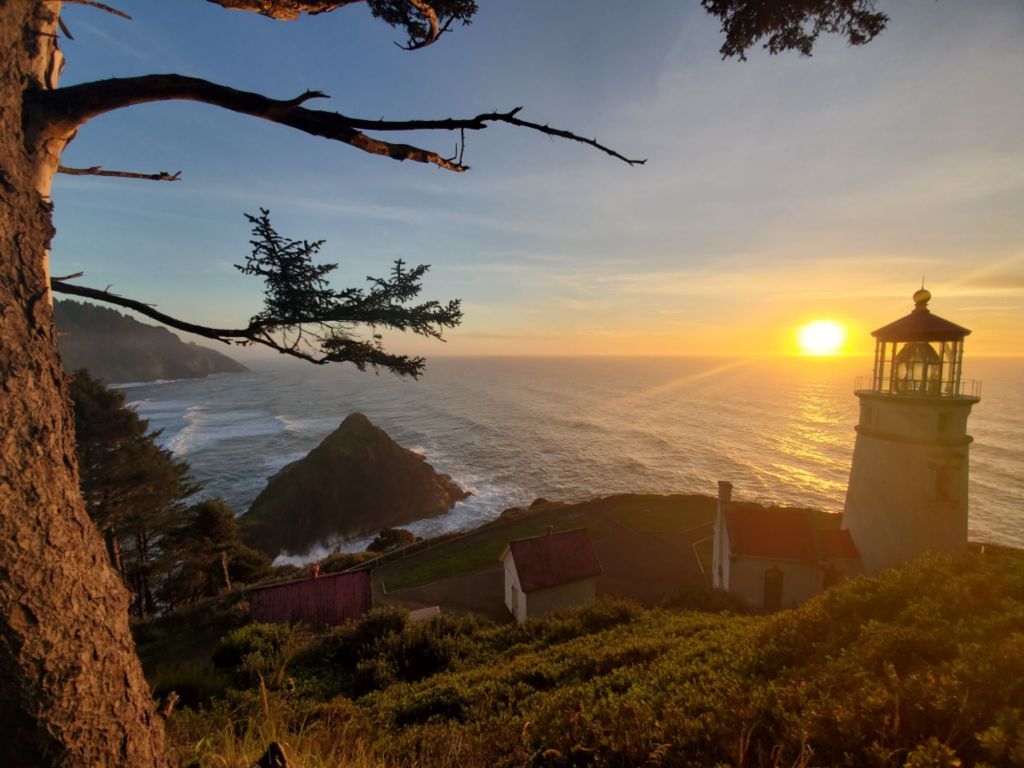
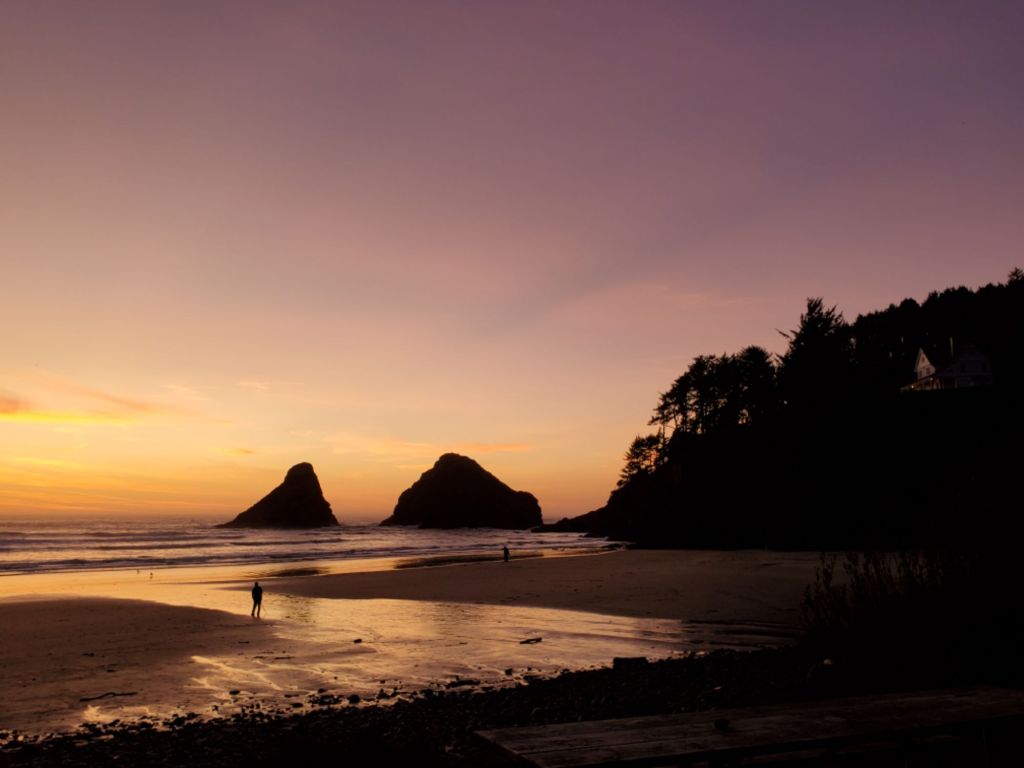
Heceta Head

Photo by Jeff Clinton

Sunset behind the lighthouse at Heceta Head on the Oregon Coast.

By Jeff Clinton

If you are a lover of lighthouses, Heceta Head on the Oregon Coast should be your first stop.

The lighthouse is situated on a cliff overlooking a picturesque cove.

There is a winding half-mile trail leading to the lighthouse and a short side trail goes up to an overlook behind the lighthouse.  It is the perfect place to sit and watch the sunset over the Pacific Ocean with the lighthouse and a gnarled tree in the foreground.

Nearby is a Bed and Breakfast in the former assistant light keeper’s home that provides fantastic views of the ocean.

It is rumored to be haunted by the wife of a former light keeper.  Her name is Rue and she keeps an eye out for her children, one of whom drowned.

Several occupants have reported items in their rooms being moved.  However, her presence is said to be a peaceful one as she watches over the lighthouse quarters.

The brick and stucco Heceta Head Lighthouse was first activated on March 30, 1894 and it was automated in 1963.

The light of its First Order Fresnel Lens can be seen from 21 miles out to sea.  Part of the great distance can be attributed to the fact the lighthouse is situated 205 feet up the headland and has a 56 foot high tower.

Heceta Head (pronounced huh-SEE-tuh) honors Bruno de Heceta, the Portuguese captain of a Spanish ship who first sighted the cape in 1775.

There is ample parking but it can fill up fast.  Restrooms are on site and there is a parking fee of $5 to be paid via credit or debit card.

The park is open year round for day use and the ground floor of the lighthouse opens for visitors as weather and staffing permit.  The top floors are closed to the public.

How to get there:

The Heceta Head Lighthouse State Scenic Viewpoint is located just off Highway 101 at 725 Summer Street, Florence. OR 97439.

It is 13 miles north of Florence and 13 miles south of Yachats.

You can cut over to Highway 101 into Florence on Highway 126 out of Eugene, or on Highway 20 and 34 out of Corvallis into Waldport just north of Yachats.

Call 800-551-6949 for information, or call the park at (541) 547-3416.  School and tour groups should email ahead to heceta.h.lighthouse@oregon.gov.

For Bed and Breakfast reservations call 866-547-3696 or go to hecetalighthouse.com.

Saltwater State Park

Photo by Tim Clinton

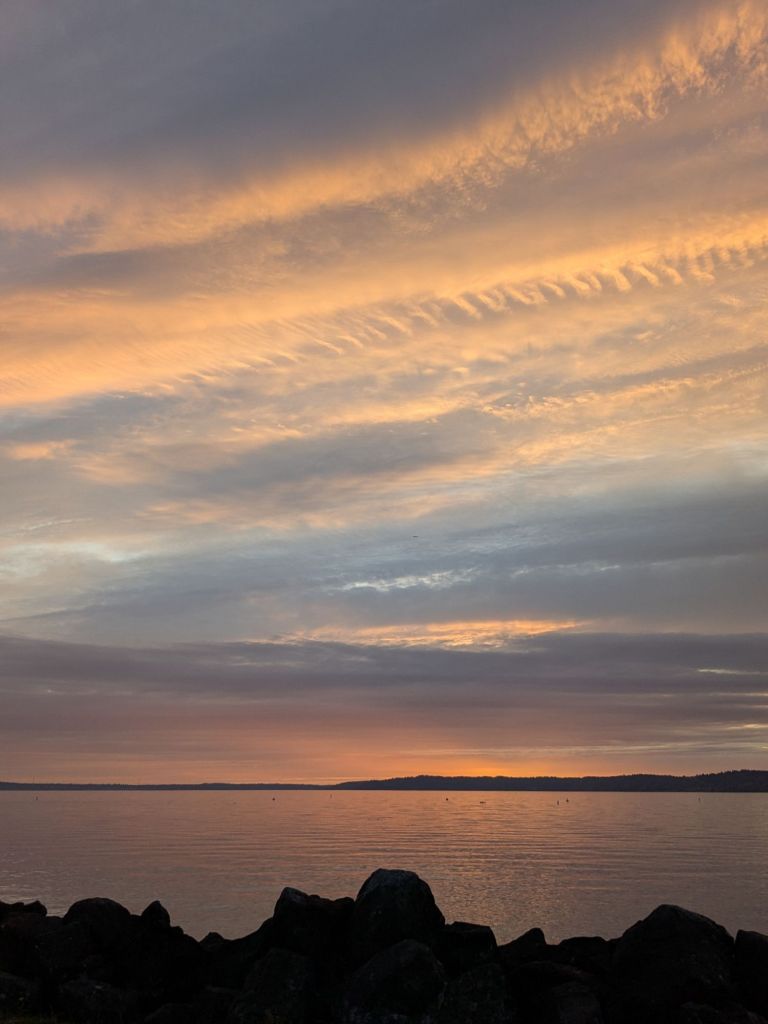
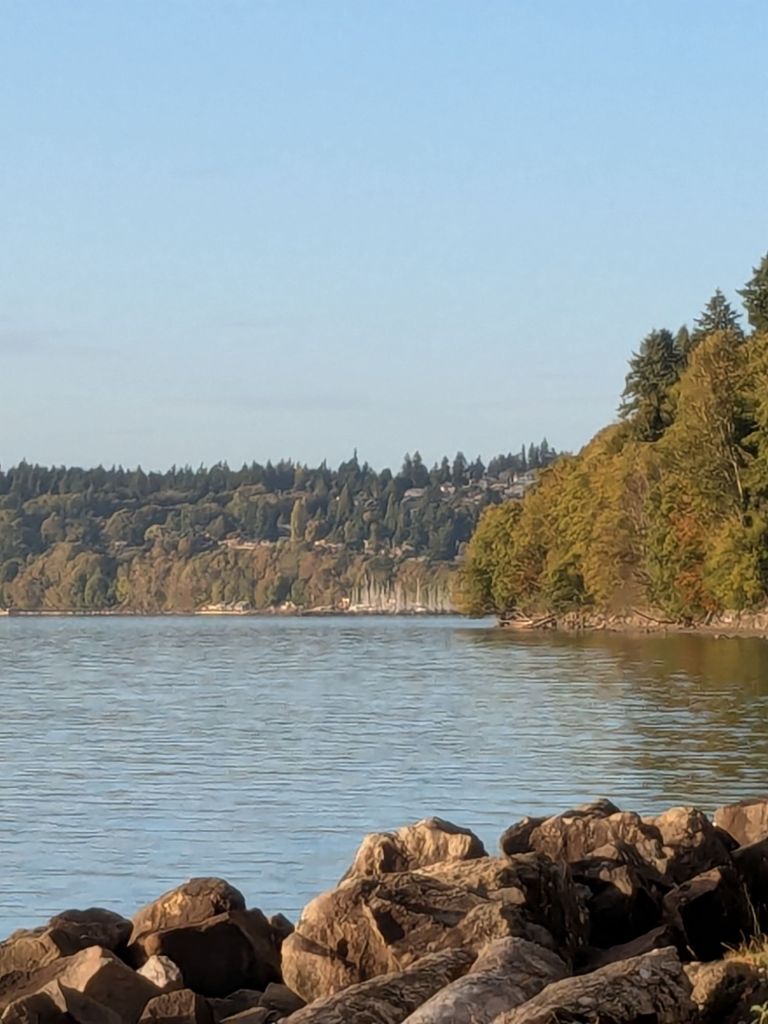
Saltwater State Park offers views of the sunset over Puget Sound and Maury and Vashon Islands.

By Tim Clinton

You never know what you are going to find at Saltwater State Park, located within the City of Des Moines in the state of Washington.

Yes, there’s plenty of salt water.

You can find it crashing against the rocks, or lapping peacefully on the sand below the wall.

There are lots of seagulls and a few crows, but if you’re lucky you can also find a blue heron sneaking up on one of the tiny fish that swim just off shore.

Some of the creatures swimming a little farther out are not tiny at all.

Sea lions often poke their heads out of the water to look around, and in recent weeks in October of 2025 playful porpoises have jumped and swam by real quick.

They arch their backs as they come up and blow air and water out of their spouts making hissing sounds.

Two appeared the first week and five could be seen coming up at once the next before vanishing under the waves.

And what’s flying overhead may not be a bird, but a drone looking down from just over the tree tops on the crest of the bluff above.

Or it could be one of the many jets that parade by just up the hill from the park on their way to Sea-Tac International Airport.

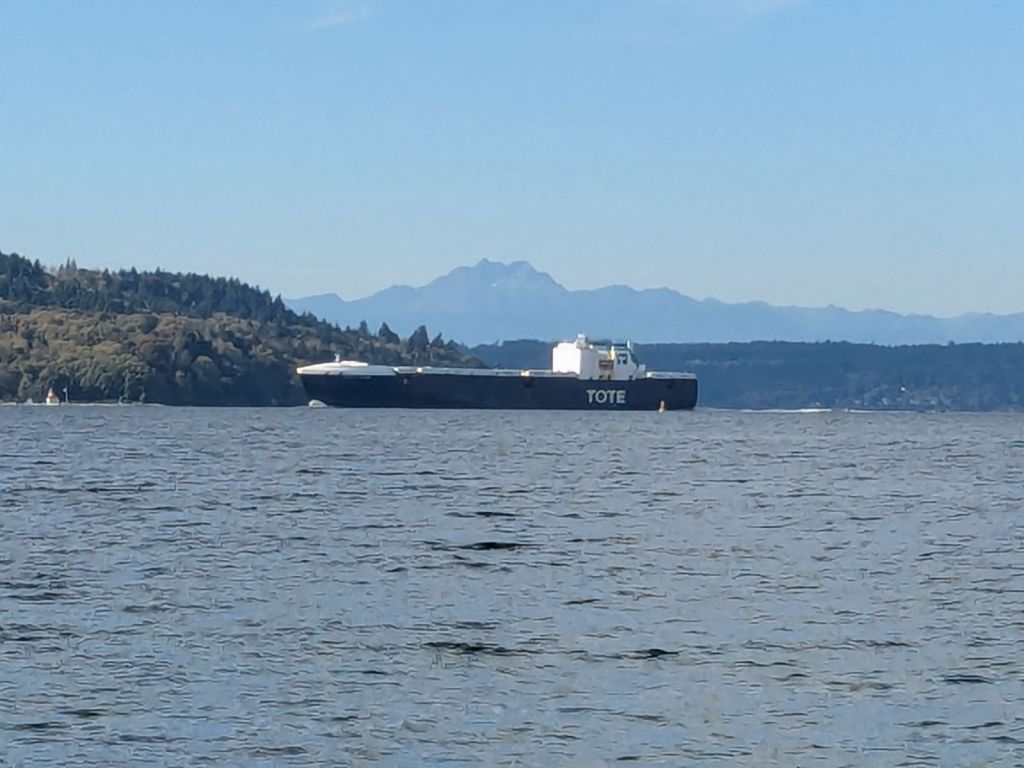
Sailboats often cruise by on Puget Sound coming or going from the Des Moines Marina to the north and if you stay long enough you could see a freighter, container ship or a tug pulling a barge.

The ships create the largest waves that later splash in, disturbing the normally peaceful rhythm on nice days.

Among the things you know you are going to find are a freshwater creek, a fire pit encircled by rocks and a bench, a restroom, a covered picnic shelter, open picnic tables and benches to sit on and look out over the water toward Maury and Vashon Islands and the Olympic Mountains beyond.

Or you can see the sunset in this direction if you are there at the right time.

A paved walking trail takes you to all of these and works its way through a grassy area, with a rock wall trying to protect it all from the onslaught of high tides and waves but obviously having failed in spots.

Washed out areas creating holes in the concrete are marked off by yellow tape and a large portion of the path starting before the covered picnic shelter is currently blocked by a closed sign for safety.

The sign is largely ignored, however, and people including many with children and dogs stroll on by and avoid the washed out side of the path or go through the grass.

The bluff above is cut into by the flat bottomed canyon created by McSorley Creek, where the parking lot and a concession stand and another restroom are.  More picnic sites are also located here.

A trail goes up the creek where a 30 site campground is located.  It is open May 15 to Sept. 15.  Campers without a reservation may stay only one night at a time.

Saltwater State Park is on a 137 acre site with 1,445 feet of shoreline.

Hiking trails are on top of the bluff, where another picnic area is located, and on the north and south rims of the canyon.

Call (253) 661-4956 for more information on the park that is open at 8 a.m. daily all year long and closes at dusk.

Reservations to camp can be made online or by calling (888) 226-7688.

The general Washington State Parks number is (360) 902-8844.

How to get there:

Take the Kent-Des Moines Road exit from Interstate 5 and go west (left northbound and right southbound) through the light on Pacific Highway and down the hill toward Des Moines.

Keep going until you come to Marine View Drive at the bottom of the hill as you enter the downtown waterfront area.

Turn left at the light by Taco Time and watch for the Saltwater State Park signs to your right.  Turn on 8th Place So.

A booth offers day use tickets for $10 per vehicle or a $30 Discover Pass that gets you into any state park in Washington for a year.

Saltwater State Park is located at 25205 8th Place So. in Des Moines with a 98198 zip code.

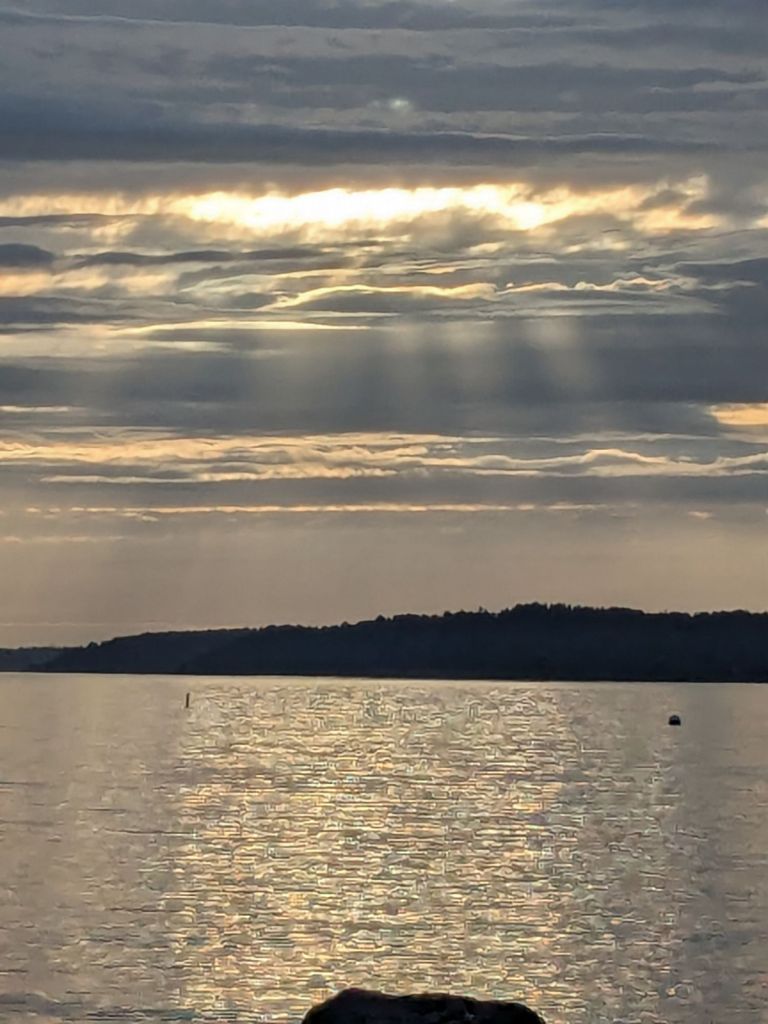
Photo by Tim Clinton

Rays of the sun come down from a hole in the clouds.

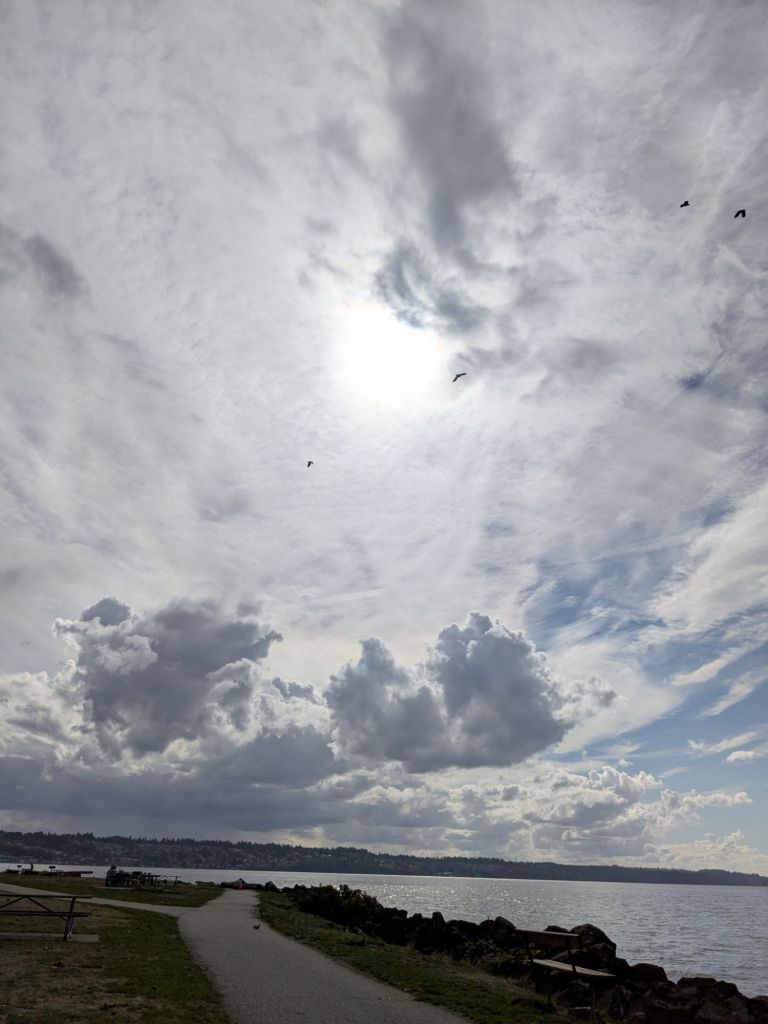
Photo by Tim Clinton

Clouds partially obscure the sun over the walkway looking toward Redondo and Federal Way to the south.

Photo by Tim Clinton

Sailboat masts at the Des Moines Marina can be seen in the view to the north from Saltwater.

Photo by Tim Clinton

Passing ships and the Olympic Mountains are visible at Saltwater State Park.

Photo by Pete Harris

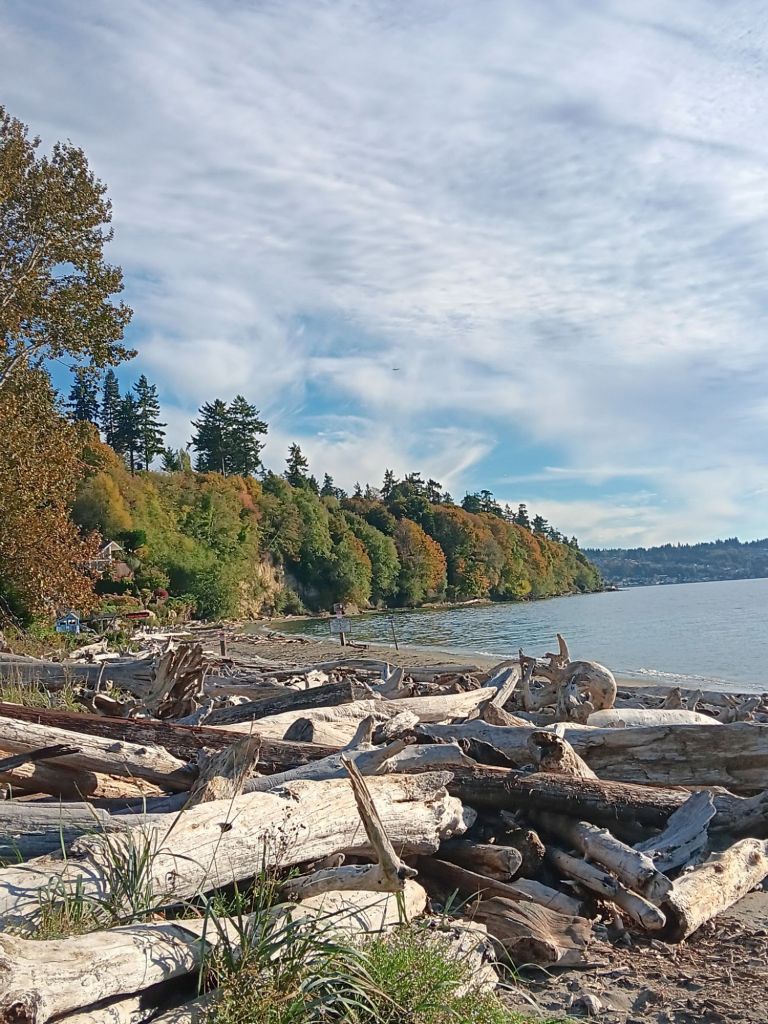
The driftwood lined southern side of the park.

Johnston Ridge

By Tim Clinton

Point blank.

Up close and personal.

Unobstructed.

Those are the words and phrases that come to mind when it comes to the view of Mount St. Helens from Johnston Ridge.

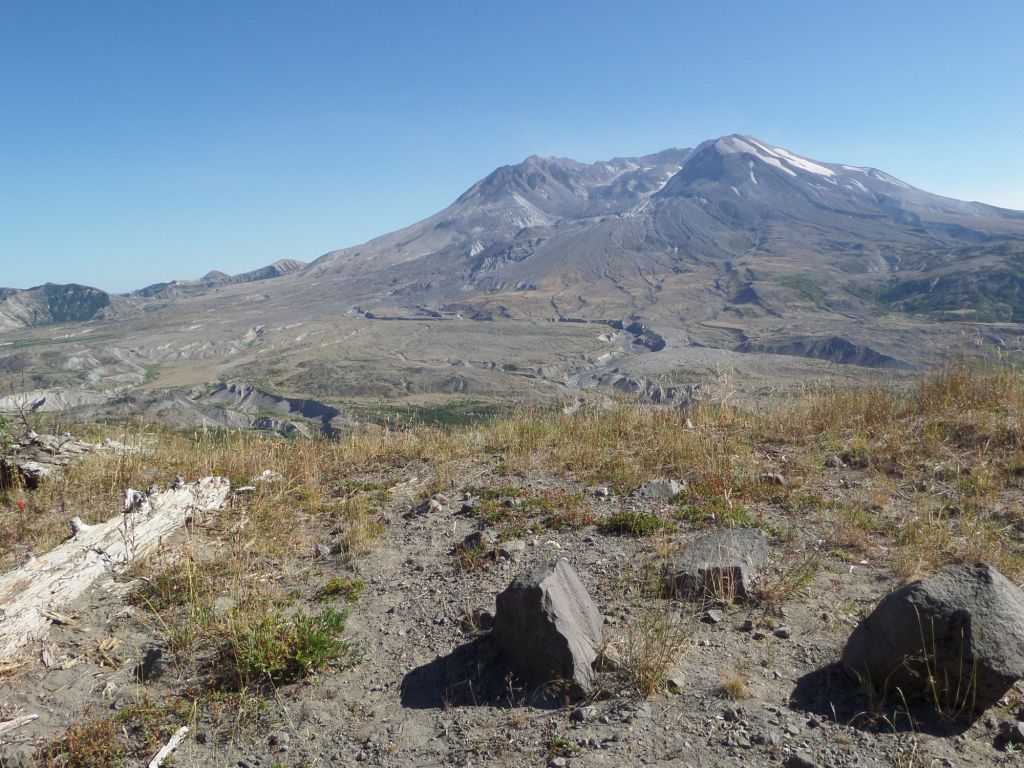
There is nothing between you and the crater and lava dome on the exploded north side of the Washington volcano as you look across from next to the Johnston Ridge Observatory.

All that is below is the landslide zone from what set off the infamous May 18, 1980 blast, including a deep canyon carved out in only the years since that would look to be much older.

You can pay to go inside the observatory and take a look at the mountain through the window and at presentations and films about its eruptions, or walk along the outside and take in the view and snap pictures.

Also impressive on Johnston Ridge besides the view of the volcano is the mixture of barrenness and dead fallen trees and tree stumps along with new life.

Grass, bushes and small trees have poked their way into the scene along with flowering vegetation such as flaming red Indian Paintbrush and white Everlasting Flowers.  Even an occasional chipmunk makes an appearance.

Highway 504 to Johnston Ridge is well paved the whole way, and you can look down on the Toutle River and the mud flow that came crashing down the valley after the 1980 landslide and blast.

You can also look up and see the west side of the mountain and part of the crater to the left.

From there the road winds down to the shores of Coldwater Lake, which was also created in 1980, then back up again as you get closer and closer to Johnston Ridge and at the mountain itself.

The road ends in a wide parking lot and there is a trail that takes you uphill to the observatory and viewpoint.

Johnston Ridge is named after David A. Johnston, the volcanologist stationed on the ridge who announced to his Vancouver headquarters and the world that “This is it” about the May 18 eruption right before his death in the blast.

How to get there:

To get to Johnston Ridge, take the Interstate 5 exit onto Highway 504 at Castle Rock and stay on it to its end 52 miles to the east.  You can also take the Highway 505 exit until it goes through Toledo and joins 504, where you take a left.

The Johnston Ridge Observatory address is 24000 Spirit Lake Highway, Toutle, WA 98649.

For more information,  call (360) 274-2140.

Photo by Tim Clinton

You get an unobstructed view of Mount St. Helens from Johnston Ridge.

Crater Lake

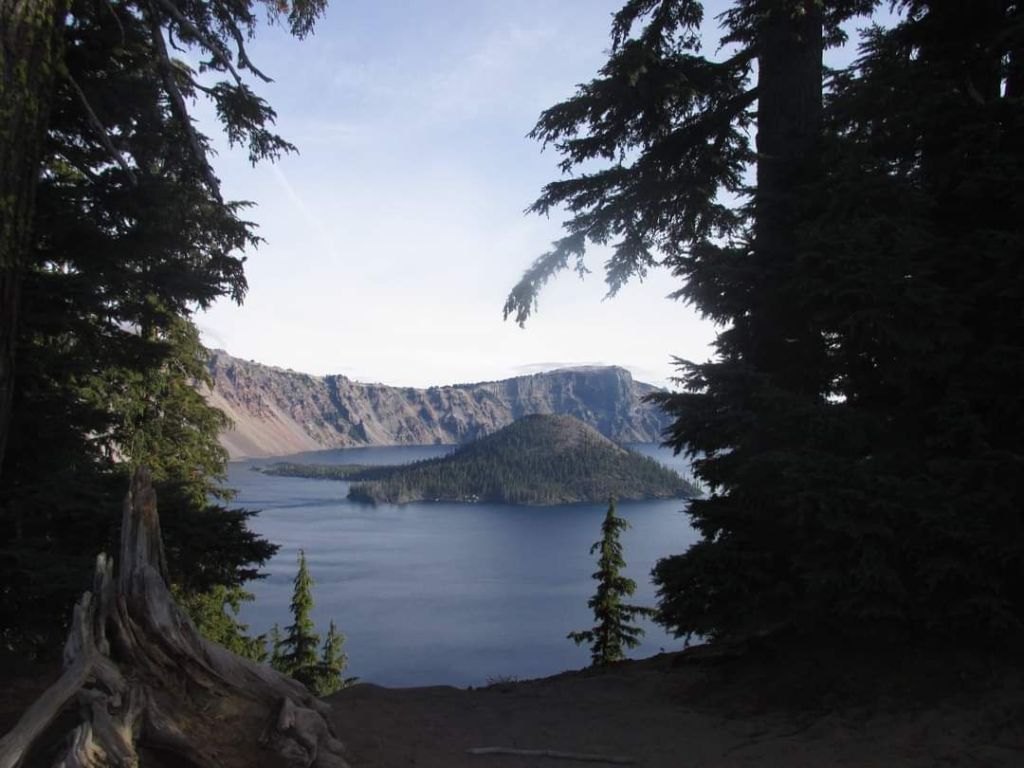
Wizard Island stands out as a landmark at Crater Lake in Oregon. (Photo by Jeff Clinton).
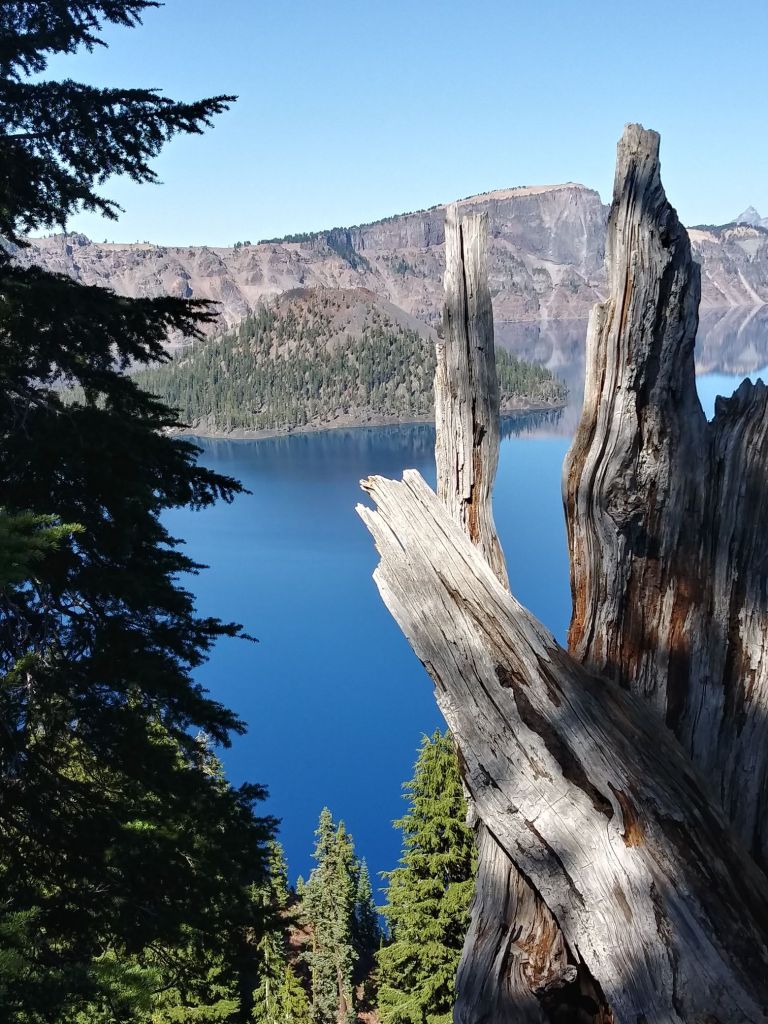
An old stump frames a scene at Crater Lake National Park.  (Photo by Tim Clinton).

By Tim Clinton

Oregon’s Crater Lake is nothing short of spectacular any way you look at it.

Deep blue waters surround tree-lined Wizard Island with its small crater on top, with steep slopes encircling the scene and plunging into the depths.

Add a layer of snow in the winter and it becomes even more stunning.

But Crater Lake is not in a crater at all.

Technically it sits in a caldera.

A caldera is formed when a magma chamber is emptied and collapses in on itself.  That’s what happened to Mount Mazama when it erupted some 7,700 years ago, with Crater Lake gradually filling it in.

“It will be a long time before they call it Caldera Lake,” admitted a tour guide at nearby Newberry Caldera trying to explain the difference.

Wizard Island was the result of ensuing volcanic activity, with its top blasted out to form a crater.

But whether you call it Crater Lake or Caldera Lake, it offers viewers a striking blue color brought on by algae.

Wizard Island is the centerpiece of most photos coming out of Crater Lake National Park.

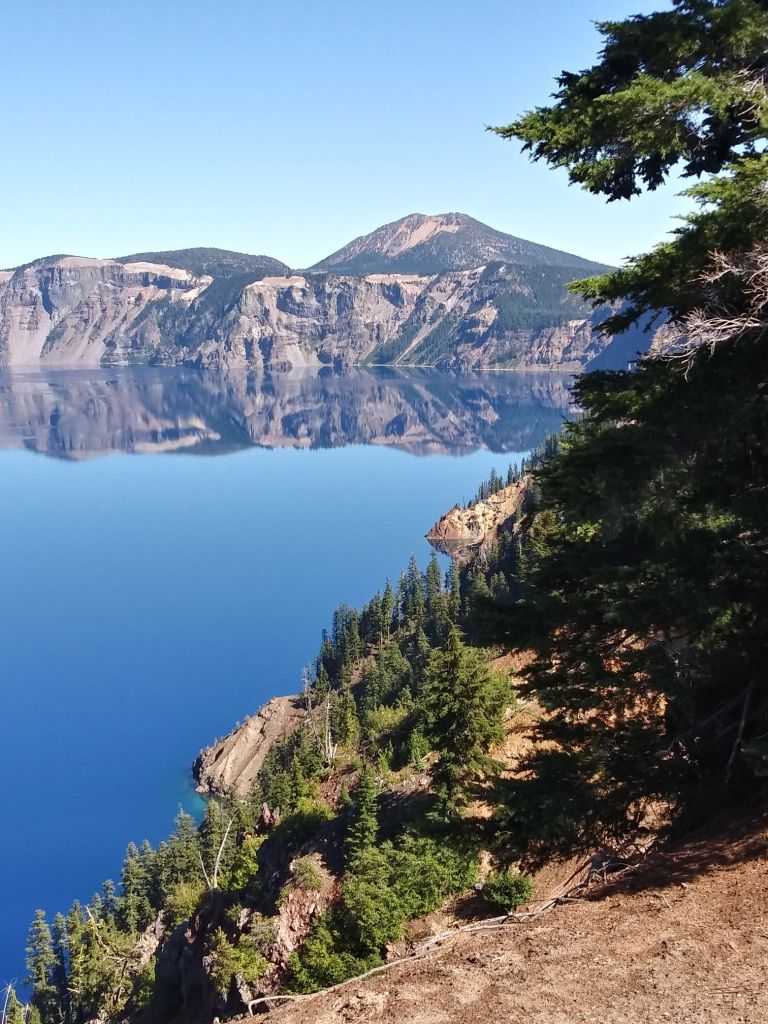
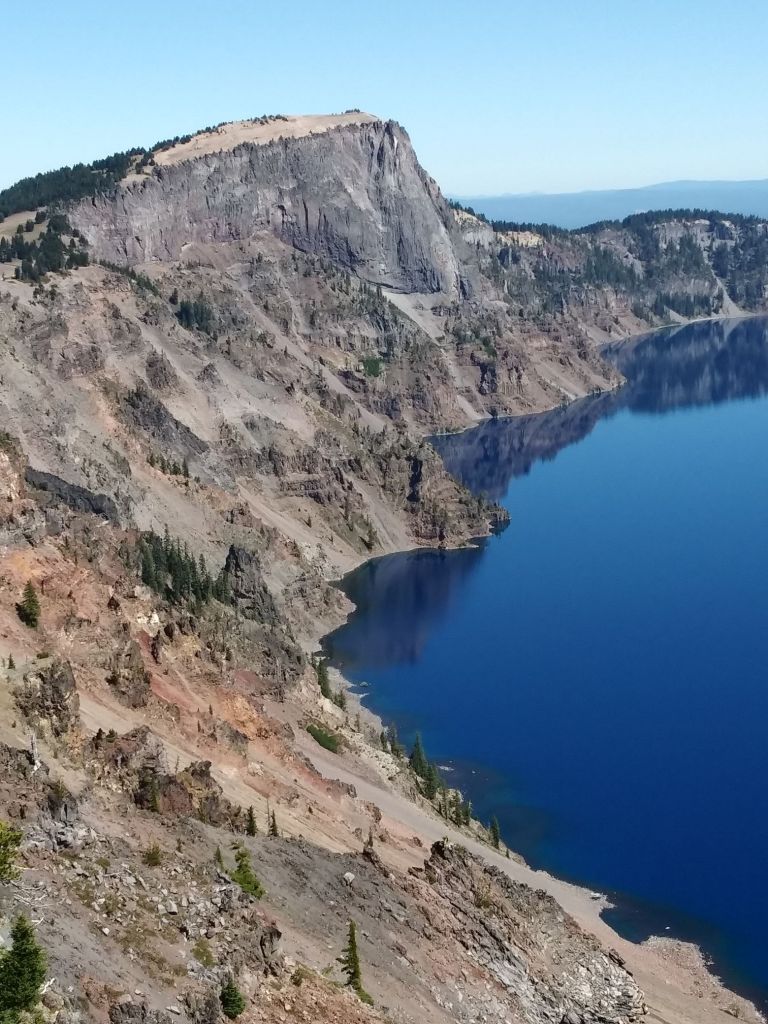
But the Southern Oregon scene stands out everywhere, with the ragged and rocky shell of Mount Mazama creating slopes that continue right down into the 1,943-foot deep lake.

A road goes around the whole caldera, weaving inside the rim at times to offer views of the lake.

The best place to see it is above the southwest portion.

It features a visitor center and lodge as well as a large parking area and trails through the trees on a fairly flat portion of land.

The lake is huge as well as deep at 4.971 miles across and covering 20.6 square miles.  The surface sits at 6,178 feet in elevation.

Crater Lake is inhabited by sockeye salmon and rainbow trout.

Parts of the park are open during the winter depending on the weather.

Boat tours of the lake are offered in the summer.

Check out the Crater Lake website for current information.

How to Get There:

From the north on Interstate 5, take Highway 138 out of Roseburg and head east up the winding  North Umpqua River.

The road turns south before you get to Diamond Lake and goes past it.  Turn right into Crater Lake National Park.

From Medford and the south on I-5, get on Highway 62 and wander north up the Rogue River before veering east at Union Creek into the west entrance of the park.

From Highway 97 to the east, you can hop on Highway 138 at Diamond Lake Junction and take a 15 mile drive to where you turn left into the park.

From Klamath Falls and the south on Highway 97, take Highway 62 before you get to Chiloquin and drive northwest into the park’s south entrance.

Views on the south side (top photo) and north side (bottom photo) of Crater Lake reveal a variety of scenery.  (Photos by Tim Clinton).

Hello World!

Welcome to the new northwestvistas.com home site of Northwest Vistas! It has been running at the northwestvistas.blogspot.com site since December of 2021. It can still be found at that address while you wait for posts and photos to appear here.

We also have sister websites at seattlesportsstories.com about Seattle and Puget Sound area pro teams and college athletics and at federalwaysports.blogspot.com.

You can find scenic photos from this site in the form of desk top calendars and posters and other items for purchase off the seattle-sports-stories.shopify.com site.

Help keep Northwest Vistas articles and photos coming your way monthly by making a donation of your choice for a voluntary subscription either one-time, monthly or yearly.

Just fill in the form below.

One-Time
Monthly
Yearly

Make a one-time donation

Make a monthly donation

Make a yearly donation

Choose an amount

$5.00
$15.00
$100.00
$5.00
$15.00
$100.00
$5.00
$15.00
$100.00

Or enter a custom amount

$

Your contribution is appreciated.

Your contribution is appreciated.

Your contribution is appreciated.

DonateDonate monthlyDonate yearly